
How to Seal a Deck: A Step-by-Step Guide for Wood Decks
In This Guide
An unsealed wood deck soaks up rain, then dries out and shrinks. Repeat that cycle for a few seasons and you get warping, cupping, surface cracking, and rot starting at the end grain and fastener holes — the places water enters fastest. A good sealer slows all of that down. It is one of the cheapest, highest-payoff maintenance jobs a homeowner can do, and it is well within DIY range: a weekend, basic tools, and patience about the weather.
When Does a Deck Need Sealing?
Most guides put resealing on a 1–3 year cycle, and that is a fair planning figure. Sun exposure, foot traffic, and climate move the real number: a south-facing deck in strong sun may need attention every year or two, while a shaded deck in a mild climate can stretch toward three or four years. Product type matters too — clear water-based sealers tend to wear fastest (often every 1–2 years), while oil-based penetrating sealers and solid stains typically last longer (roughly 2–5 years for oils, 3–5 for solid stains, depending on exposure).
Watch for these signs that protection has worn off:
- Water soaks in instead of beading. This is the decisive test (below).
- Gray, faded, or dull boards. Sunlight breaks down both wood fibers and the old finish.
- Surface splintering or small cracks. Repeated wet-dry cycles are doing damage.
- Mildew or dark patches in shaded corners. Damp wood that never fully dries invites growth.
New decks are a special case. Fresh pressure-treated lumber holds moisture from the treatment process, and sealing too soon can trap it and cause peeling within a season. One major manufacturer advises waiting at least 30 days before sealing new pressure-treated timber; other guides put the drying window at six weeks to six months depending on climate and how long the boards sat at the lumber yard. Rather than guessing by the calendar, run the water test below — when the wood absorbs water readily, it is ready to accept sealer.
The Water-Bead Test
This simple test is the standard check used by manufacturers and deck pros alike:
- Wait for dry wood. Test after a few sunny, dry days. A deck that is already saturated from rain will bead water even when its protection is gone, which gives a false pass.
- Sprinkle water on several areas. Test sunny boards, shaded boards, and steps separately — they wear at different rates.
- Watch for a few seconds. If the water soaks in and darkens the wood within about five seconds, the surface is porous and ready to seal. If it beads up and sits on top, the old sealer is still working — wait and test again later.
Repeat the test every spring. High-traffic spots (stairs, doorways, main walkways) wear faster and may need touch-ups between full reseals.
Choosing a Sealer: Oil-Based vs Water-Based
Deck sealers fall into two broad families, and the choice is a trade-off between ease and longevity:
- Water-based sealers: Lower odor and VOCs, easy soap-and-water cleanup, and fast drying — typically touch-dry in 1–3 hours and ready for a second coat in 2–4 hours. The trade-off is a shorter service life, often 1–2 years for a clear product.
- Oil-based penetrating sealers: Soak deeper into the wood, give a richer look, and generally last longer (about 2–5 years). They take longer to dry — touch-dry in roughly 4–12 hours and up to about 72 hours to fully cure — and need mineral spirits for cleanup.
Within either family you will also choose an opacity: clear sealers show the wood grain but offer the least UV protection and wear fastest; semi-transparent stains add some color and UV blockers and last about 2–3 years; solid stains hide the grain almost like paint and can last 3–5 years, but they sit on the surface and can peel if moisture gets underneath. A good rule of thumb: the clearer the finish, the more often you will need to reapply it.
Whichever product you buy, the label on the tin has the final say on drying times, temperatures, and recoat windows. Read it before you start, not halfway through.
What You’ll Need
- Deck cleaner (oxygenated bleach-based cleaner for general grime; a dedicated deck brightener for grayed wood)
- Stiff-bristle brush or push broom, plus a garden hose or pressure washer on a low, fan setting
- Sealer — check the label for coverage (a common figure is roughly 150–400 sq ft per gallon, varying with how porous the wood is)
- Applicator: brush for edges and railings, pad applicator or roller for open boards, sprayer for large decks (always back-brush after spraying)
- Sandpaper (80-grit) and a scraper for rough spots, plus replacement screws for any popped fasteners
- Painter’s tape and drop cloths for siding, stone, and plants near the deck
- Safety gear: gloves, eye protection, and old clothes — and keep rags soaked with oil-based product flat or in a sealed metal container, as they can be a fire risk if bunched up
Step 1: Clean the Deck
Sealer bonds to clean wood. Anything left on the surface — dirt, mildew, old flaking finish — gets trapped under the new coat and weakens it.
- Clear and sweep. Move furniture, planters, and grills off the deck. Sweep out debris, including the gaps between boards.
- Apply deck cleaner. Wet the deck, spread the cleaner per the label, and scrub with a stiff brush. Pay attention to shaded, damp corners where mildew grows.
- Rinse thoroughly. Hose off all cleaner residue. If you use a pressure washer, keep the pressure low and the nozzle in a wide fan pattern, held at a consistent distance — a narrow jet held too close can gouge soft wood fibers.
- Let it dry completely. Allow 2–3 dry days before sealing. Wood that looks dry on top can still hold moisture deeper down, and sealing damp wood traps that moisture.
Step 2: Repair and Sand
Walk the deck and fix what you find before the sealer goes on: drive popped screws back down (or replace them), tighten loose boards, and replace any board that is soft, spongy, or rotted — sealer cannot save rotted wood. Lightly sand rough or splintered areas with 80-grit paper, and sand any remaining flaking old finish until it is sound. Sweep or blow off all sanding dust; dust left on the surface interferes with adhesion.
Step 3: Apply the Sealer
Pick your weather first. The ideal window is a dry stretch of at least two to three days with temperatures roughly between 50°F and 90°F (10°C–32°C), no rain forecast for at least 24 hours after application (48 hours is safer), and no direct hot sun on the boards while you work — finish applied in blazing sun can dry too fast to penetrate properly, leaving a blotchy result. Morning or late afternoon is usually best on hot days.
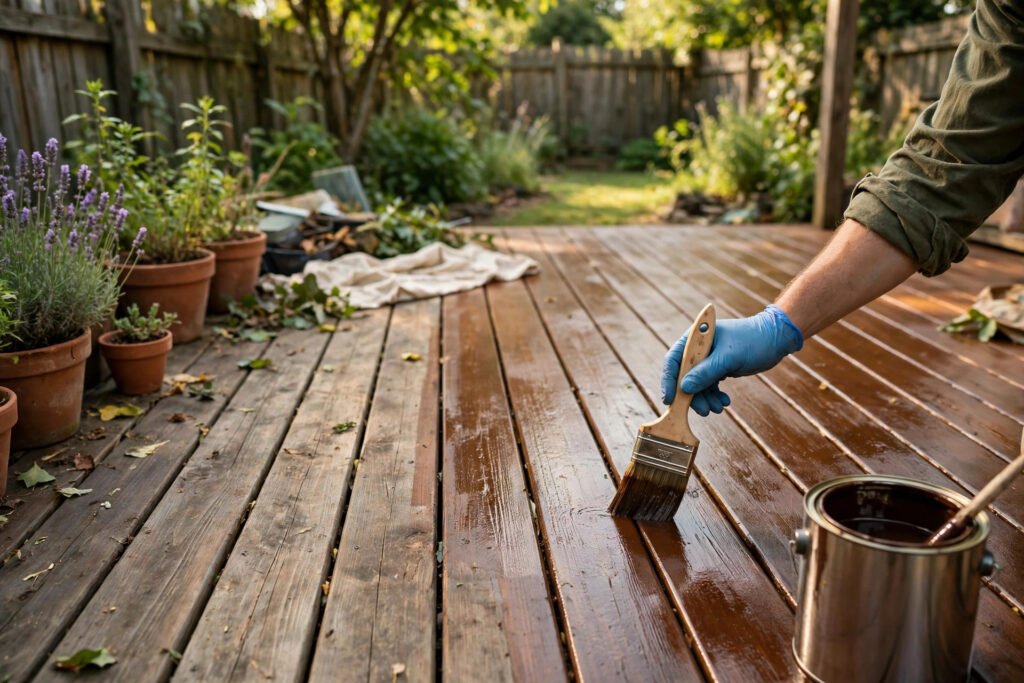
- Start at the far end. Work away from your exit so you never paint yourself into a corner. Do railings and vertical surfaces first, top to bottom, then the floor.
- Work two or three boards at a time, along their length. Keep a wet edge so each new section blends into the last without lap marks.
- Apply thin, even coats. Two thin coats beat one thick coat that pools or fails to cure. With a sprayer, follow immediately with a brush (back-brushing) to work the product into the grain and wipe up excess. With oil-based penetrating products, wipe off any excess that has not soaked in after about 15–30 minutes, or it can dry into a sticky film that cracks or peels.
- Observe recoat times. A second coat, if the label calls for one, typically goes on after a few hours for water-based products and up to a full day for oil-based formulas.
- Let it cure. Keep foot traffic off for at least 24–48 hours, and up to about 72 hours for oil-based sealers. Do not put furniture back until the finish is fully hardened — dragging a chair across a soft finish will mark it permanently.
Pay extra attention to end grain (the cut ends of boards) and fastener holes: those spots absorb water fastest and benefit from a generous coat.
What Sealing a Deck Costs
DIY sealing is mostly a materials job: a gallon of quality sealer typically covers roughly 150–400 sq ft depending on the wood’s porosity, so a mid-size deck often needs 2–4 gallons, plus cleaner and applicators. Hiring a pro to clean and seal a deck commonly runs several hundred dollars and up depending on deck size, condition, and region — get two or three local quotes, and confirm whether the price includes cleaning, repairs, and the number of coats. Either way, compare that against the cost of replacing boards: regular sealing is far cheaper than rebuilding a deck that rotted for lack of it.
Mistakes to Avoid
- Sealing wet or dirty wood. The two most common causes of peeling and patchy finishes.
- One heavy coat instead of two thin ones. Thick coats pool, skin over, and cure poorly.
- Sealing in direct sun or before rain. Both ruin an otherwise good application.
- Sealing composite decking. Composite boards are engineered to resist moisture without a sealer, and coating them is unnecessary — and may affect the manufacturer’s warranty. Clean them instead, per the manufacturer’s guidance.
- Skipping the test. Sealing a deck that still beads water wastes product and can build up a sticky, layered finish.
Deck Sealing FAQs
How often should I seal my deck?
Typically every 1–3 years, but let the water-bead test decide. Clear water-based sealers wear fastest (about 1–2 years); oil-based penetrating sealers and solid stains last longer (roughly 2–5 years), depending on sun exposure and climate.
How do I know if my deck needs sealing?
Sprinkle water on dry boards in several spots. If it soaks in and darkens the wood within a few seconds, the old protection has worn off. If it beads up and sits on the surface, the sealer is still working.
Can I seal a deck in cold weather?
Most products need temperatures roughly between 50°F and 90°F (10°C–32°C) during application and curing, with no rain for at least 24 hours. Check your product’s label — cold or damp conditions slow curing and can cause a blotchy or weak finish.
How long after sealing can I walk on my deck?
Allow at least 24–48 hours before foot traffic, and up to about 72 hours for oil-based sealers to fully cure. Keep furniture off until the finish is fully hardened.
Do composite decks need sealing?
No. Composite decking is made to resist moisture, UV fading, and mold without a sealer, and sealing it may affect the manufacturer’s warranty. Clean composite decks according to the manufacturer’s instructions instead.
How long should I wait before sealing a new deck?
At least 30 days for new pressure-treated lumber, and often longer — some guides allow six weeks to six months for the wood to dry. Use the water-bead test rather than the calendar: when water soaks in readily, the wood is ready.
Is one coat of deck sealer enough?
Some products are designed for one coat; many benefit from two thin coats. Follow the label. Two thin coats almost always outperform one thick coat, which can pool and cure poorly.
Related: Outdoor & Garden DIY hub · Home maintenance guides · Cost guides · Tools & DIY skills